 Language
 Español
 Português
 Français
 Deutsche
 हिन्दी
 Nederland
 Русский
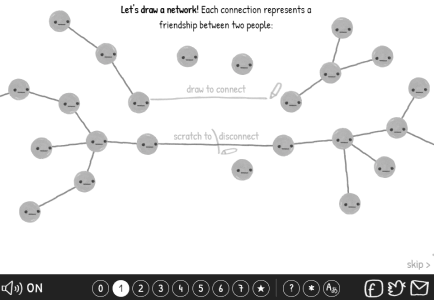
The Wisdom and/or Madness of Crowds
Rating: 4.33 from 5 (based on 12 votes. 👍 10 – users like it, 👎 2 – disliked, 💬 0 – comments posted)
Released: July 2020
The Wisdom and/or Madness of Crowds – Interactive Network Theory Sandbox
“The great triumphs and tragedies of history are caused, not by people being fundamentally good or fundamentally bad, but by people being fundamentally people.” This interactive prototype turns that idea into a hands-on explorable explanation. In The Wisdom and/or Madness of Crowds you draw social networks, test ideas like the Majority Illusion, and see how the structure of connections can make the same people behave kindly or cruelly, smart or silly. Play free online on PlayMiniGames — no downloads, just click and explore. 🧠
What This Interactive Is About
Rather than telling you how groups work, the prototype lets you discover it yourself. You will sketch a network, place agents, and observe how local views differ from global reality. The experience is part art toy, part educational simulator, showing how perception can be warped simply by who connects to whom.
Key Ideas You Can Explore
- Local versus global perception: why your neighborhood of friends can misrepresent the whole.
- Majority Illusion: a small, well-connected minority can look like a majority to most people.
- Social contagion: attitudes and behaviors spread differently depending on network shape.
- Small worlds and hubs: shortcuts and highly connected nodes amplify visibility and influence.
How to Play
- Draw your own network: click and drag to add nodes and connections, or reshape existing links.
- Assign behaviors: toggle which nodes “do X” to simulate a trend, opinion, or habit.
- Check perceptions: each node shows the fraction of its friends doing X and flips when a local majority appears.
- Solve the puzzle: try to fool every node into thinking a majority does X, even if globally it is a minority.
Why It Matters
From campus drinking myths to viral hashtags and political bubbles, networks often fool us. The prototype shows why many believe their view is common sense, why fringe ideas look mainstream, and why conflicts escalate into perceived majorities. Understanding these patterns helps you read online crowds more clearly and design healthier communities.
Tips and Strategies
- Place behaviors on high-degree hubs to maximize apparent visibility.
- Create clusters with many internal links so each member sees a local majority.
- Add a few shortcuts between clusters to propagate the illusion across the graph.
- Iterate quickly: small rewires can flip entire neighborhoods’ perceptions. 🔁
Who Will Enjoy This
Fans of explorable explanations, teachers looking for a classroom demo, designers of social apps, and curious players who like systems that reveal themselves through play. It’s a short, replayable sandbox that rewards tinkering and aha moments.
FAQ
Is this a game or a learning tool?
Both. It’s an interactive sandbox with a built-in puzzle that teaches core network theory ideas through play.
Do I need prior knowledge of networks?
No. The interface is visual and intuitive. You will learn concepts like hubs, clustering, and the Majority Illusion by experimenting.
What is the Majority Illusion?
When a small but well-connected minority appears as a majority to most people because many nodes’ local neighborhoods are dominated by it.
Can I draw any network I want?
Yes. Add nodes, connect them, and toggle behaviors to test different structures and scenarios.
Does it work on mobile?
Yes. The prototype runs in desktop and mobile browsers on PlayMiniGames.