 Language
 Español
 Português
 Français
 Deutsche
 हिन्दी
 Nederland
 Русский
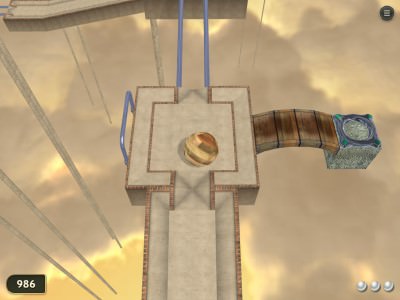
Ballance
Rating: 4.38 from 5 (based on 13 votes. 👍 11 – users like it, 👎 2 – disliked, 💬 0 – comments posted)
Released: October 2026
Ballance is a classic 3D physics puzzle game where you control a rolling ball across narrow platforms, ramps, bridges, rails, and other suspended structures without falling into the void. Originally developed by German studio Cyparade and released in Europe in 2004, the game combines careful movement with physics-based puzzles and increasingly difficult obstacle courses. ⚪🧩
The central mechanic is the ability to transform your ball into three different materials: wood, stone, and paper. Each version has its own weight and physical behavior, so choosing the correct material becomes essential for solving puzzles and reaching the end of each level.
Play Ballance online on PlayMiniGames and guide the ball through challenging 3D courses where precision, momentum, physics, and route planning all matter.
What Is Ballance?
Ballance is a 3D puzzle game originally created for Microsoft Windows by Cyparade and published by Atari Europe.
Its gameplay is often compared with Marble Madness because the player directly controls a rolling ball and must guide it along dangerous courses without falling.
However, Ballance expands the idea with material transformations, physics puzzles, moving objects, rails, ventilators, checkpoints, and increasingly complex level designs.
Control a Ball Across Dangerous Courses
The basic goal is simple: move the ball from the beginning of a level to the end.
The challenge comes from the environment.
Many paths are narrow, elevated, unstable, or designed around physical interactions. Moving too quickly can send the ball over an edge, while moving too slowly may make some obstacles harder to overcome.
Precise control is therefore more important than raw speed.
13 Levels
The supplied description states that Ballance contains 13 levels in total.
The original release included 12 levels, while an additional downloadable level called Level 13: Speed was later made available through the developer's website.
The levels gradually become more difficult and introduce new mechanics as the player progresses.
Transform the Ball
One of the most important mechanics in Ballance is material transformation.
Special transformer pads allow the player to change the ball into one of three materials:
- Wood
- Stone
- Paper
Each material has a different weight and physical behavior, and many puzzles can only be solved by choosing the correct form.
Wooden Ball
The wooden ball is the most balanced and stable of the three forms.
You begin and finish each level using the wooden ball.
Because it is neither extremely heavy nor extremely light, it is useful for general movement and many standard physics puzzles.
The wooden form is often the safest option when a puzzle does not require the special characteristics of stone or paper.
Stone Ball
The stone ball is extremely heavy.
Its weight makes it more difficult to control near edges, but the same weight makes it powerful enough to move heavy objects.
The supplied description states that the stone ball can push boxes and other balls that lighter forms may struggle to move.
It can also cause wooden plank bridges to collapse simply by rolling across them.
Paper Ball
The paper ball is very light.
It cannot push heavy objects effectively, but its low weight gives it several important advantages.
Ventilators can blow the paper ball into the air, allowing it to reach places that heavier balls cannot access.
The paper ball can also climb steep slopes more easily.
Its surface is less smooth than the wooden or stone ball, so its movement can feel slightly less predictable.
Physics-Based Puzzles
Ballance constantly asks the player to think about weight, momentum, gravity, and balance.
You may need to push another ball down a slope, move an object into a hole, cross a fragile bridge with the correct material, or use a ventilator to carry the paper ball upward.
Many challenges are not solved simply by moving forward. You must understand how the objects in the environment react to each other.
Push Objects to Open the Way
Some routes are blocked until you manipulate other objects correctly.
The supplied description mentions pushing balls down slopes, into holes, or onto rails in order to continue.
This means Ballance is as much about environmental problem-solving as it is about careful movement.
Checkpoints
Falling from a platform does not always mean restarting the entire level.
Checkpoints are positioned throughout the courses.
After reaching one, falling from the track causes the player to restart from the most recent checkpoint rather than returning to the beginning.
This becomes increasingly useful in later levels where the challenges are longer and more complex.
Extra Ball and Point Power-Ups
Ballance contains two types of power-ups according to the supplied description.
One grants an extra ball, effectively giving the player another chance after a mistake.
The other provides additional points.
Collecting them can reward careful exploration and precise movement.
Side-Rail Challenge
Level 3 introduces the side-rail mechanic.
Instead of rolling on a conventional flat path, the ball must travel sideways along a pair of vertically aligned rails.
This requires careful positioning because the margin for error becomes much smaller.
The mechanic is one of the examples of how Ballance gradually introduces more demanding balancing challenges.
Mono-Rail Challenge
By Level 12, the game introduces an even more difficult rail section.
The ball must balance directly on a single rail.
Because there is almost no room for sideways movement, the player must make extremely small corrections to avoid falling.
This is one of the clearest examples of the game's progression from simple rolling to precise balancing.
Increasing Difficulty
The 12 original levels become progressively more difficult.
Early stages help players understand basic movement and transformation mechanics.
Later levels combine multiple systems at once, including narrow tracks, heavier physics puzzles, rail balancing, unstable surfaces, and object manipulation.
The game therefore rewards patience and learning rather than rushing through every section.
How to Play Ballance
Ballance is controlled with the keyboard according to the supplied description.
The exact key layout is not provided in the source, so players should follow the controls displayed by the current browser version.
A typical level involves:
- Rolling the ball along elevated tracks
- Avoiding falls
- Using transformer pads
- Switching between wood, stone, and paper
- Pushing boxes and other balls
- Using ventilators
- Crossing fragile bridges
- Balancing on rails
- Activating checkpoints
- Reaching the end of the level
Tips for Ballance
- Move slowly near narrow edges.
- Use the wooden ball when you need stability.
- Switch to stone when you need to push heavy objects.
- Use the paper ball for ventilators and steep slopes.
- Do not carry too much momentum into sharp turns.
- Activate checkpoints whenever possible.
- Plan object-pushing puzzles before moving everything.
- Use small corrections on rail sections.
- Remember that the stone ball can destroy fragile wooden bridges.
- Expect later levels to combine several mechanics at once.
Why Players May Enjoy Ballance
Ballance may appeal to players who enjoy 3D puzzle games, rolling-ball games, physics challenges, Marble Madness-style gameplay, precision platforming, logic puzzles, and classic PC games.
Its strongest feature is the way movement and puzzle-solving are connected. The player is not only navigating an obstacle course but also deciding which material form has the correct weight and properties for each situation.
Players searching for Ballance online, Ballance browser game, Ballance 2004, rolling ball puzzle game, Marble Madness alternative, physics ball game, wood stone paper ball game, or classic 3D puzzle game may find this title especially relevant.
Ballance Features
- 3D physics puzzle gameplay
- Originally released in 2004
- Developed by Cyparade
- Published by Atari Europe
- 12 original levels
- Additional Level 13: Speed
- Wooden ball transformation
- Stone ball transformation
- Paper ball transformation
- Weight-based physics puzzles
- Object pushing
- Collapsing bridges
- Ventilators
- Side-rail sections
- Mono-rail balancing
- Checkpoints
- Extra ball power-ups
- Point bonuses
- Increasing level difficulty
- Browser play on PlayMiniGames
FAQ About Ballance
What is Ballance?
Ballance is a 3D physics puzzle game where you guide a rolling ball through suspended courses while solving puzzles and avoiding falls.
When was Ballance released?
The supplied description states that Ballance was first released in Europe on April 2, 2004.
How many levels are in Ballance?
The game originally contained 12 levels, with an additional downloadable Level 13 called Speed.
What types of balls are available?
You can transform between wooden, stone, and paper balls, each with different weight and physical behavior.
What is the wooden ball used for?
The wooden ball is stable and balanced, making it useful for general movement and many standard puzzles.
What is the stone ball used for?
The stone ball is extremely heavy and can push objects or collapse fragile wooden bridges.
What is the paper ball used for?
The paper ball is very light, can be lifted by ventilators, and can climb steep slopes more easily.
Does Ballance have checkpoints?
Yes. Checkpoints allow you to restart from the most recently reached point after falling from the course.
Is Ballance similar to Marble Madness?
Yes. Both games involve controlling a rolling ball through dangerous courses, although Ballance adds material transformations and more elaborate physics puzzles.
Can you play Ballance online?
Yes. The version described here can be played in the browser on PlayMiniGames.