 Language
 Español
 Português
 Français
 Deutsche
 हिन्दी
 Nederland
 Русский
Wayfarer
Rating: 4.38 from 5 (based on 13 votes. 👍 11 – users like it, 👎 2 – disliked, 💬 0 – comments posted)
Released: August 2026
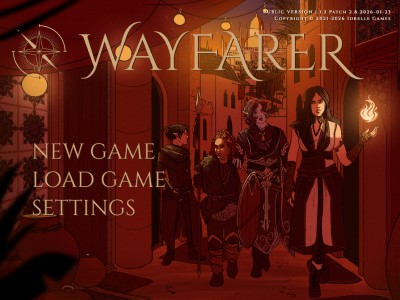
Wayfarer is a dark fantasy interactive fiction RPG set in the continent of Rhesainia, a world where magic is highly valued and those immune to it are rare. You play as one of the last surviving Wayfarers, members of a shattered Order once dedicated to protecting people from terrifying creatures and magical disasters.
Your story begins as mercenary work forces you into a dangerous contract: travel to the city of Velantis and steal an ancient artefact. What looks like a straightforward job quickly becomes much larger. Rival factions, powerful guilds, political conflict, mysterious enemies, and secrets about your own identity pull you into a branching narrative where every success and failure can change the direction of the story ⚔️.
Play Wayfarer online on PlayMiniGames and experience a massive choice-driven fantasy adventure combining novel-style storytelling, RPG character building, skill checks, dice rolls, relationships, and thousands of branching decisions.
What Is Wayfarer?
Wayfarer is a dark fantasy interactive fiction game developed by Idrelle Games, the studio name of solo developer and playwright A.M. Morrigan.
The game combines three major influences: the depth of a fantasy novel, the decision-making of a role-playing game, and the uncertainty of tabletop dice mechanics.
You create your own Wayfarer, choose their background and abilities, build relationships with companions and factions, and make decisions that alter both immediate scenes and long-term story outcomes.
Failure is not treated simply as a game-over state. Failed checks and poor outcomes can open alternative narrative routes, making unsuccessful actions part of the story rather than something that always needs to be reloaded.
The Story of the Wayfarers
Wayfarers are people marked by an unusual trait: immunity to magic.
In Rhesainia, where magic plays an important role in society, this makes them fundamentally different from most people around them. For generations, the Wayfarer Order travelled across the continent protecting communities from dangerous beasts and enchantments that had gone out of control.
That Order no longer exists as it once did. It was broken apart, leaving only a small number of survivors who still follow its creed.
Your protagonist is one of those survivors.
This history shapes how the world reacts to you and also becomes central to the mystery surrounding what Wayfarers truly are.
Travel to the City of Velantis
The main adventure leads you to Velantis, a city filled with competing interests and political tension.
Your initial task sounds simple: steal an ancient artefact.
Once you arrive, however, the job becomes tangled in conflicts between factions, guilds, and powerful individuals. Political tensions continue to rise while you uncover information connected to your own origins.
The deeper you become involved, the more the central mystery expands beyond one mercenary contract.
Eventually, your investigation leads toward a secret capable of challenging the foundations of the world itself.
Create Your Own Wayfarer
Character customization is a major part of Wayfarer.
You can customize your protagonist’s gender, pronouns, appearance, and other personal details. The game also lets you choose from six ancestries and five origins.
These choices are not purely cosmetic. Ancestry and origin help define your Wayfarer’s background and can influence how their personal journey is framed.
You also choose skills that are later used during checks and narrative decisions.
This gives different characters different strengths and weaknesses, encouraging replaying the game with new builds rather than making the same protagonist every time.
Skill Checks and Dice Rolls
Wayfarer uses RPG-style skill checks and dice mechanics to determine how certain actions unfold.
You may choose an action that seems correct but still fail the associated check. Likewise, a successful roll can open an opportunity that might otherwise remain inaccessible.
The important difference is that failure does not necessarily end the scene.
Instead, the story can continue along a different path. Failed actions may reveal new information, create complications, damage relationships, or lead to scenes that successful characters never encounter.
This makes both success and failure worth experiencing.
Thousands of Branching Choices
Wayfarer is built around extensive branching narrative design.
The supplied description states that the game contains thousands of branching choices and more than 900,000 words of adventure in its broader development state.
Choices can affect dialogue, faction relationships, companion reactions, skill outcomes, and the direction of entire scenes.
Some decisions are also timed. During these moments, players cannot simply analyze every possibility indefinitely. The timer creates pressure and forces faster decisions during important situations.
Because of the number of possible routes, replaying is strongly encouraged.
Seven Companions
Throughout the story, you can meet seven major companions.
These characters are designed to have meaningful relationships with your Wayfarer rather than serving only as temporary side characters.
Your choices can strengthen or damage those relationships.
You may develop friendship, romance, rivalry, distrust, or even intense hostility depending on how you behave.
The game explicitly allows relationships to move in both positive and negative directions, so keeping every companion happy is not necessarily the only valid way to play.
Six Rival Factions
Velantis is shaped by six factions competing for influence and control.
Your relationship with each faction can improve or deteriorate depending on your decisions.
Supporting one group may make another less cooperative, while attempting to remain neutral can create challenges of its own.
Because these factions are tied to the future of Velantis, your choices can eventually influence what happens to the city itself.
This adds a political layer to the personal story of the protagonist.
Failure Can Create New Paths
One of Wayfarer’s core ideas is that failure should not always be treated as something that needs to be erased.
A failed roll may produce a completely different conversation, encounter, or consequence.
Instead of immediately loading an earlier save whenever something goes wrong, consider continuing the story and seeing what happens.
Some of the most interesting scenes may only become available because a character failed at the expected moment.
This design gives the game a tabletop-RPG feeling where unexpected outcomes become part of the adventure.
Public Episodes and Ongoing Development
Wayfarer is an episodic game that is still in development.
According to the supplied description, the public release includes:
- Prologue
- Episode I
- Episode II
The supplied source also states that Episode III is complete and available separately in early access through the developer’s Patreon.
It is described as not being planned for the public build until the Episode IV alpha is finished.
Because Wayfarer remains in development, future release timing and episode availability can change.
Save Files in the Browser
Wayfarer is an HTML5 game and normally stores saves in the browser.
This means your progress may be lost if the browser clears its cache, history, or stored site data.
The developer therefore recommends creating independent save files using the Save to Disk option.
These files can later be restored using Load from Disk.
This is especially useful for a long interactive fiction game where a playthrough may contain many hours of decisions.
Tips for Playing Wayfarer
- Do not reload automatically after every failed skill check.
- Experiment with different ancestries and origins on later playthroughs.
- Pay attention to faction relationships before making political decisions.
- Remember that companion approval is not the only valid relationship path.
- Expect some important choices to be timed.
- Create manual save files with Save to Disk.
- Try different skill builds when replaying.
- Explore both successful and failed outcomes.
- Revisit the game with a different personality and decision style.
- Read carefully because small choices can influence later scenes.
Content Warning
Wayfarer is rated MA-17 according to the supplied description.
The game includes mature material such as violence, blood and gore, death, strong language, sexually suggestive themes, and drug and alcohol use.
Players sensitive to these themes should consider the content warning before beginning.
Wayfarer Credits
Wayfarer is developed by Idrelle Games, the studio name used by Canadian solo developer and playwright A.M. Morrigan.
The in-game cover and companion cards are credited to Rory Yaya.
The Wayfarer sigil and logo were designed by Jessica Roy, while additional artwork was created by A.M. Morrigan.
Other assets are credited within the game itself.
Why Players May Enjoy Wayfarer
Wayfarer may appeal to players who enjoy dark fantasy interactive fiction, text RPGs, choice-based games, tabletop-inspired mechanics, romance systems, political fantasy, companion-driven stories, and deeply branching narratives.
The combination of dice rolls and narrative choices means two playthroughs can develop differently even when they begin with similar intentions.
Its extensive character customization also makes it possible to approach Velantis from very different perspectives.
Players searching for Wayfarer game, Wayfarer interactive fiction, Idrelle Games Wayfarer, dark fantasy text RPG, choice-based fantasy game, tabletop interactive fiction, browser fantasy RPG, or romance interactive fiction may find this project especially relevant.
Wayfarer Features
- Dark fantasy interactive fiction
- Novel-style storytelling
- RPG character customization
- Tabletop-inspired dice mechanics
- Six playable ancestries
- Five character origins
- Custom gender and pronouns
- Skill-based checks
- Success and failure branches
- Thousands of player choices
- Timed decisions
- Seven major companions
- Romance and relationship systems
- Six rival factions
- Political choices affecting Velantis
- Extensive replay value
- Browser-based HTML5 saves
- Save to Disk and Load from Disk support
- Episodic development
FAQ About Wayfarer
What type of game is Wayfarer?
Wayfarer is a dark fantasy interactive fiction RPG combining novel-style storytelling, player choices, skill checks, dice rolls, and tabletop-inspired mechanics.
What is a Wayfarer?
Wayfarers are people immune to magic who once belonged to an Order dedicated to protecting Rhesainia from dangerous beasts and magical disasters.
Where does Wayfarer take place?
The adventure is set in Rhesainia, with much of the story focused on the politically divided city of Velantis.
Can you customize your character?
Yes. You can customize gender, pronouns, appearance, ancestry, origin, skills, and other aspects of your Wayfarer.
How many companions are in Wayfarer?
The supplied description lists seven major companions whose relationships with the protagonist can change significantly.
Does Wayfarer have romance?
Yes. Relationships with companions can potentially develop into romance, while other choices may instead create rivalry or hostility.
Does failing a skill check end the game?
No. Failure can send the story down a different narrative path and may reveal scenes or outcomes unavailable through success.
How many factions are in Velantis?
There are six major factions competing for influence and control of the city.
Which episodes are included in the public release?
According to the supplied description, the public version includes the Prologue, Episode I, and Episode II.
How do saves work in Wayfarer?
The HTML5 version saves to the browser, but players are advised to use Save to Disk because browser cache or history clearing can erase local saves.